Challenges Without the Awkwardness
Replace contrived "zombie island" scenarios and blindfolded obstacle courses with honest physical puzzles. Gravity, water flow, solar angles, and structural tension give immediate feedback without putting anyone on the spot.
What makes an outdoor challenge adult-friendly?
Many traditional team-building exercises rely on artificial scarcity, trick instructions where the facilitator withholds a crucial rule, or high-adrenaline races that reward only the loudest or fastest participants. In adult workplace and community groups, those tactics often breed cynicism rather than trust.
Drawing on experiential education frameworks pioneered by Kurt Hahn, Karl Rohnke's non-contact Project Adventure adaptations, and agricultural extension field days, our challenges replace human referees with natural physics:
- Transparent rules from minute one: No trick wording or hidden sabotage. The brief is printed clearly on weatherproof boards.
- Inter-team federation, not elimination: Sub-teams manage adjacent sectors of a single system (e.g., Intake Headworks, Viaduct Span, and Distribution Manifold). If Sector B leaks, Sector A and C help adjust the gradient.
- Physical comfort by design: Zero blindfolds, zero compulsory physical touching, and seated tactical control roles in every challenge.
Four Field-Tested Collaborative Challenges
Each challenge below scales from 8 to 40 participants by adding modular span sections.
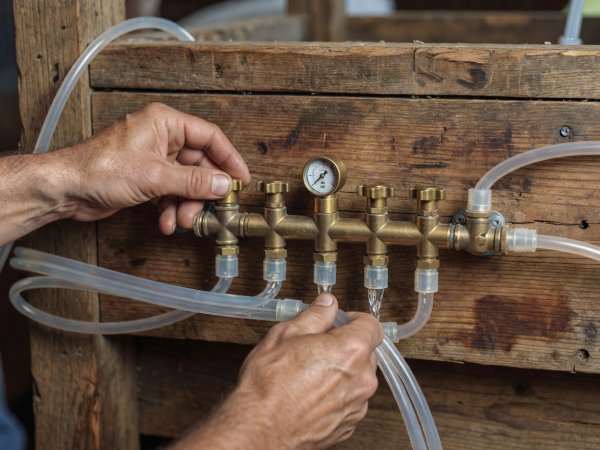
The Brief: A 60-litre header butt sits at the top of the lawn. Three thirsty sapling basins sit 18 metres away at varying distances and elevations. Using split moso bamboo channels, tripod shear-legs, spirit levels, and brass 3-way diverter tees, the whole group must deliver exactly 15 litres (±0.5L) into each basin simultaneously in a single valve release.
Survey & Gradient Hub (Seated/Standing)
Use water-tube spirit levels (bunyip levels) and sighting rods to calculate the 1:80 fall required across uneven ground.
Trestle & Suspension Riggers
Erect self-standing bamboo tripods and adjustable friction hitches so channel height can be tuned to the millimetre.
Joint Sealers & Splitter Calibration
Fashion natural beeswax-and-hemp gaskets at channel overlaps and calibrate the 3-way splitter baffles using test cups.
The Brief: Based on Leonardo da Vinci's self-supporting reciprocal roof grids, sub-teams assemble notched hazel and ash struts into interlocking pentagons without nails or screws. Each strut rests on the previous one and supports the next, requiring calm synchronised lifting as the 4-metre wide crop-protection dome rises.
Node Blueprint Navigators (Seated)
Manage the colour-coded scale model on the central table and call out the over-under weave sequence for each ring.
Ring Strut Lifters
Hold and slot the interlocking ash battens in groups of five while maintaining even inward radial tension.
Tension Strap & Fleece Crew
Secure reusable cam-buckle webbing around the base perimeter ring and clip on the horticultural frost fleece panels.
The Brief: Teams are given polycarbonate twin-wall panels, dark slate thermal-mass tiles, sheep-wool insulation batts, magnetic compasses, and digital max/min soil probes. Within 45 minutes, they must orient, insulate, and glaze a modular propagation frame to achieve a target internal microclimate delta (+6°C above ambient without overheating).
The Brief: An alternative to frantic orienteering races. Using botanical dichotomous keys, hand lenses (10x loupes), and grid coordinates, roving pairs identify specimen trees and heritage companion plants around the garden, radioing leaf-morphology clues back to the Base Table team who assemble a seasonal planting matrix.
Facilitator Debrief Prompts That Stay Grounded
When a challenge finishes, avoid clinical therapy questions ("How did that make you feel about your career?"). Instead, ask concrete operational questions around the hardware for 10 minutes while people have a warm drink:
1. On Information Flow
"When the water level in Sector 3 ran high, how long did it take for that measurement to reach the people adjusting the header valve in Sector 1?"
2. On Prototyping Early
"Which helped more: debating the bamboo joint angle on paper for ten minutes, or pouring a 2-litre test jug down the trough early to watch where it dripped?"
3. On Role Handovers
"Where did you notice two sub-teams assuming the other group was responsible for checking the spirit level across the boundary joint?"